
Control systems

One control stack from command to motion

Nautix provides the autonomy backbone. HSC and ETSC translate standard control signals into hydraulic steering, gear selection and throttle movement for remote-control outboards.

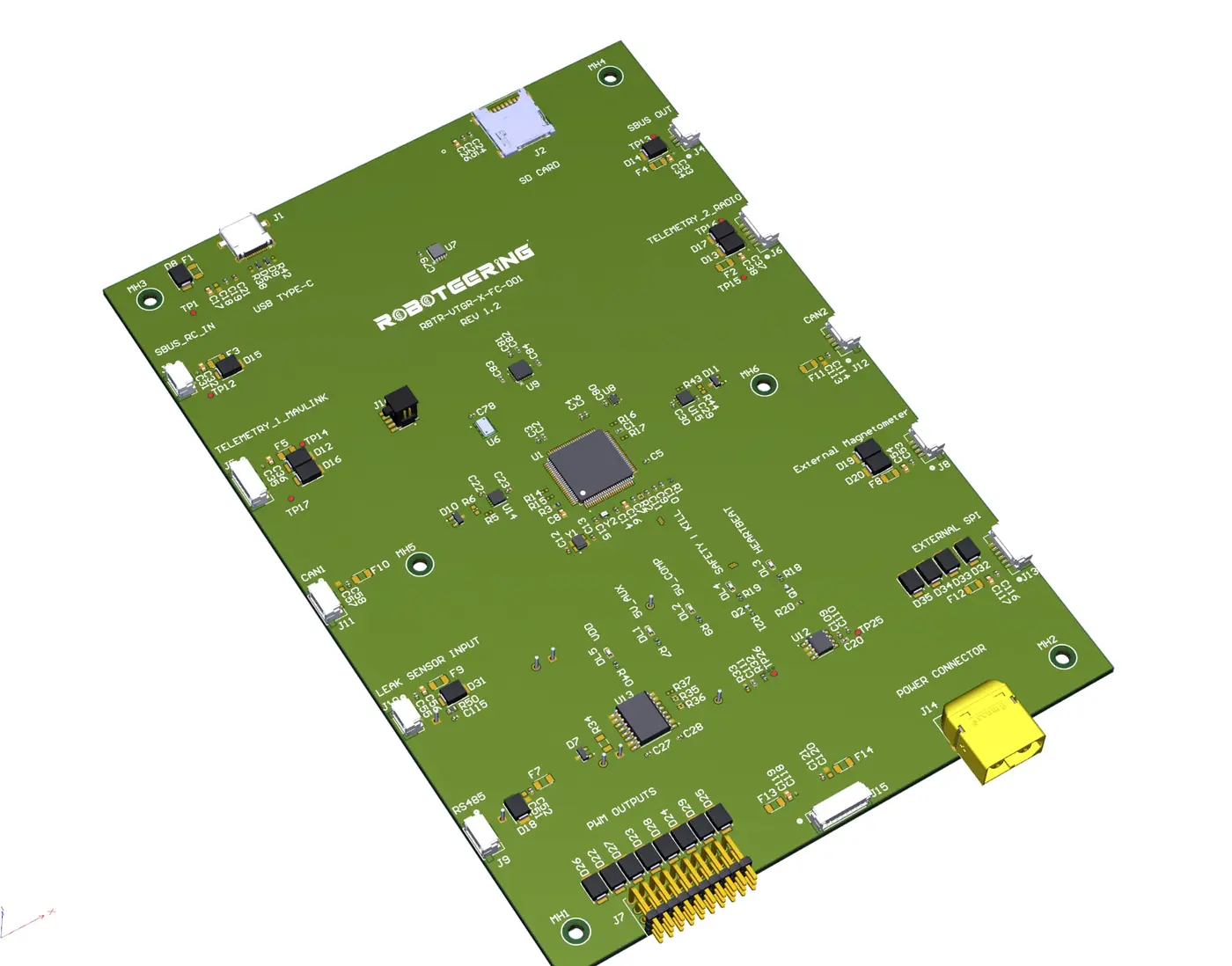
Nautix marine flight controller circuit board
Nautix REV-2 USV flight controller
01 / Autonomy backbone Bench-validated REV-2 prototype

Nautix flight controller

Nautix is a marine-oriented, ArduPilot-compatible controller designed to simplify USV wiring, expansion and field service. It provides a stable control layer across Voyager platforms and customer payload configurations.

Outputs
10 PWM channels
Data interfaces
CAN, UART, I²C and RS-485
Companion link
USB connection to embedded or industrial computer
Operations
SBUS, microSD logging and dedicated safety input
Validated functions
USB/MAVLink, SBUS, kill input, PWM, CAN and microSD logging
Ask about Nautix

Outboard control

Standard autopilot commands, conventional marine hardware

HSC and ETSC are being developed for Voyager 4200 and for retrofit use on other remote-control outboard vessels with compatible steering and cable arrangements.

HSC / HYDRAULIC STEERING CONTROL Prototype development

Autonomous hydraulic steering

HSC converts a standard PWM steering command into reversible hydraulic pump control while preserving a practical manual steering and takeover path.

  • PWM steering input using ArduPilot Function 26
  • Bidirectional hydraulic-pump drive
  • Direction, stop and fault logic
  • Adjustable response for waypoint steering
ETSC / ELECTRONIC THROTTLE & SHIFT CONTROL Prototype development

Coordinated throttle and gear control

ETSC translates a standard control command into coordinated movement of the throttle and shift cables. A separate handheld source supports manual fly-by-wire operation.

  • Forward, neutral, reverse and proportional throttle
  • Two 100 mm cable actuators
  • Configurable travel and deadband
  • Neutral-on-start and shift-at-idle interlocks
  • Throttle rate limiting and fault response
01 / COMMANDNautix or Pixhawk classSteering, direction and throttle control signals.
02 / TRANSLATEHSC + ETSCPump drive, travel control, interlocks and failsafe logic.
03 / ACTUATEHydraulics + cablesSteering cylinder plus throttle and shift actuators.
04 / MOVERemote-control outboardSteering, forward, neutral, reverse and throttle.

Companion computing

Compute sized to the platform and payload

Nautix remains the deterministic vehicle-control layer. A USB-connected companion computer handles payload software, networking, video, AI and higher-level mission services.

COMPACT DEPLOYMENTS

BlueOS-based embedded computing

Suitable for compact payload integration, common marine sensors and lightweight onboard services on smaller Voyager configurations.

  • Compact embedded computer
  • Browser-based payload management
  • USB connection to Nautix
HIGHER-COMPUTE DEPLOYMENTS

Industrial PC with Windows IoT

Designed for demanding sensor suites, native instrument applications, multi-stream video, AI processing and larger payload workloads.

  • Expanded processing and storage
  • Native Windows sensor applications
  • USB connection to Nautix

Integration model

Compatible where standards matter

Roboteering supports established autonomy tools and interfaces where they fit the platform. Proprietary marine hardware adds the control, power and mechanical functions needed for a complete vehicle.

01

Autonomy

ArduPilot-compatible vehicle control and Mission Planner workflows.

02

Data

MAVLink telemetry between vehicle, companion computer and shore systems.

03

Hardware

Clean integration with common Pixhawk-class signal conventions.

ArduPilot is a registered trademark of Software in the Public Interest, Inc. Pixhawk is a registered trademark of Dronecode Project, Inc. MAVLink, Mission Planner and BlueOS are used for identification purposes only. Roboteering is not affiliated with or endorsed by these projects.

Bring autonomy to an electric or outboard-powered USV

Share your steering, propulsion and companion-computer architecture. Roboteering can help define the control interfaces and validation path.

Discuss your control system